Posts

Showing posts with the label Rembrandt

What I Learned from My Ink Wash Drawings

Image
Philip Koch, The Trees, sepia, 30 x 42", 1985 All of us are on a long journey. Who we are today is the product of sometimes amazingly contradictory influences. For an artist every medium they employ offers them a different lesson.  I was in my painting storage room organizing work for my upcoming solo exhibition at the Washington County Museum of Fine Arts (Nov. 8, 2014 - Feb. 22, 2015).  I stumbled upon four of my large ink wash drawings, snugly resting in the painting racks. That was enough to spin me off into reminiscing how they played a decisive role in my growth as a painter. A little history:  When I first began painting I was attracted to the geometric abstractions of the 1960's and painted with big flat shapes of intense acrylic colors. As I reached grad school at Indiana University I unexpectedly fell in love with the University Art Museum's 19th century landscape paintings. They propelled me into a darkly moody world, with me painting in o...

Drawing V.S. Color: The Great Arm Wrestling Contest

Image
I'm going to be giving a talk next month that will be titled Three Things You Didn't Know About Edward Hopper  up at the Hopper House Art Center in Nyack, NY. There are dozens of things I could touch on. One topic I may talk about is Hopper's talents as a colorist, which in my mind were considerable. Early in his career Hopper did dozens of beautiful etchings like the one above of cows ambling over some railroad tracks. Hopper's strengths with color in part stem from his long practice at mastering traditional drawing issues- creating expressive flat shapes, composing darks and lights, building solid volumes. Let's look at the cows above. Two of them are partly obscured by a foreground shadow but the third has clambered up into the light. It's pyramid-shaped back is highlighted against the far distant dark forest. You sense there's something about the house that reminds you of what you've seen and felt in that cow. Surely it's the shape of...

More Sharp Teeth

Image
The experience of living can be like trying to take a drink from a fire hose- there's just too much coming at you too fast.  In the previous post I talked about using drawings to pare down the overwhelming complexity to make the sense of it. Paintings that try to encompass everything fail every time. The irony is we have to back away from a direct confrontation with nature if we're going to make landscape paintings that can ever do her justice. Making drawings is a way to do that, stripping away color and dealing just with shapes and darks and lights. It's getting down to essentials.  I'm illustrating this post with more of the series of vine charcoal drawings I did last week up in the Adirondack Mountains in northernmost New York State. I've been going there regularly for the last half dozen years and feel I get a better understanding of the potential of those mountains for making paintings with each visit.  When I was still an undergraduate art major at Obe...

Light Revealing/Light Concealing

Image
Here's Rembrandt as a young man. Think of how many self portraits you've seen where the painter's eyes stare out at you as the key feature of the painting. Not so here.  Rembrandt's having a ball playing around with the light direction, bringing out only the shapes on his skull he feels best evoke the feeling he's after. Instead of a left eye we're given a darkened bird's nest of an eye socket with a bottom left edge carved by the turning silhouette of the artist's cheekbone. Cleverly, Rembrandt interests us the thing next to  the eye we wanted to see. The portrait is of course lit from behind, pushing the whole right side of the chin, jaw, and neck and far shoulder into a flat dark silhouette. We don't see much of his lower lip, but we don't miss it as the empty space right under his jaw seems to glow with its own shimmering personality. It's as if Rembrandt is painting himself by painting a portrait of the space n...

The Subtle Power of Gradation

Image
My daughter Louisa was joking around with me the other night. She was planning to take a bunch of her students to the Walters Art Museum in Baltimore and she asked which of their exhibits I would recommend. Pausing a bit she said "of course ever since I was little you and my mom have been brainwashing me that all abstract art is bad." Ribbing me, she wondered aloud if my advice should be trusted. Naturally I was bowled over by this unanticipated accusation and took awhile to pick myself up off the floor and remove the sharp arrow that had pierced my heart. Could I really be that narrow?  It is true my heart lies with the realist painters most of the time and long time readers of this blog know I talk about the Hoppers, the Rockwell Kents, the Winslow Homers, and the like way more than I do contemporary art. But my rebuttal of the charge I'm biased against abstraction (much less against current concept  driven art) would of necessity be pretty short. One thing in my favo...

A Guide for Collectors on How to See Your Paintings

Image
If you are a collector who lives with paintings on your walls you may have noticed a problem with your artworks. After a while, you stop seeing them. Once when they first joined you they almost called out to you by name..."LOOK at me"...and you did. But the dust of familiarity gradually settles over your works and strangely, they become harder to see. Fortunately there's help. Artists' main job is to see more and deeper than everyone else. We practice. There are tools in an artist's box that might not occur to the average person. These are things I do in my studio all the time to help me see more clearly- some I was taught and other tricks I stumbled upon in my years of making paintings, Anyone, artist or just an art lover, can benefit. Here goes with a short list. Stand Back Above is an early oil painting by Rembrandt titled An Artist in his Studio.  The artist has painted himself standing easily a dozen feet back from his work in progress. I have a rule in...

What You Can Learn from Ink Wash Drawings

Image
The ability to draw well is a hallmark of a real artist.  If you want to be exciting, learn how to draw really, really well. At least that's true in my book. Let me explain. I started out as an abstract painter because I couldn't draw from observation particularly well and all my teachers in undergraduate school pushed abstraction. But after a while I realized I needed something deeper in my painting and switched to working in a realist vein.  At first this meant building up my drawing skills. I did this almost entirely by working from the nude model. It was hard as heck to get the drawn figures to look human and to look like they weren't falling off the page. But after several thousand attempts I improved dramatically.  There's a problem with just drawing a model on a model stand. If you're not careful you develop the bad habit of just looking at the model. He or she is up there somewhat isolated from the rest of reality. While that's a good thing when one i...

A little Rembrandt

Image
Only the time (and energy) for a short post today as I'm dealing with some sad personal business this week. Hopefully I'll be back to a more regular blogging schedule in a few days.  Above is a very tender painting of one of Rembrandt's wives bathing. I always wondered if she was doing this at midnight or in a cave it's so dark. Yet that darkness is a foil for the brilliant light on the woman's torso. We sense this woman has a depth and personality to her in part because she generates a variety of shapes for our eye. Look at the rounded edge of her updrawn bottom hem compared to the almost straight lines of the "v" shaped neckline. One of the big challenges an artist faces is getting a variety of lines into the painting, and then getting them to look like they're in conversation with each other. Rembrandt does this swimmingly here. This painting of a stone bridge deftlly knits together the heavens and earth. Notice how the painting has a series of...

A Cure for Impatience- Drawing

Image
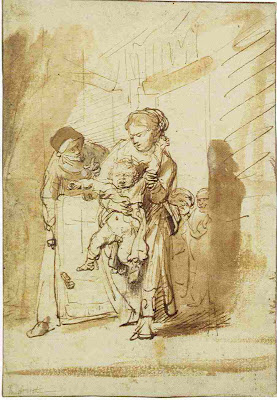
Here's an ink wash drawing by Rembrandt. Almost 400 years since the guy drew it and it still has things to tell us. Look at the elegant anatomical precision of the woman's head at the left! (you can click on the image for a larger version). Actually I'm pulling your leg. That head isn't particularly well drawn. But therein lies much of what is so good about this drawing. Rembrandt was using this drawing to help him discover what it was in this scene that he was most genuinely interested in. Instead of a polished finish we get the feeling the artist is groping his way forward. Initially he's not sure exactly what he's after.  He uses the time spent making this drawing to slow himself  down and sift through the possibilities. It's funny as one would think one knows what one likes. Yet art shows us our first answer may not be the best answer.  So often a piece of art fails because the artist tries to do everything and ends up accomplishing very little. Remb...

Welcome Home

Image
This is my studio this morning. Late yesterday the four heavy wooden crates came home carrying my paintings from my national traveling exhibition Unbroken Thread: The Art of Philip Koch. These same crates carried the show out to Washington State to the Clylmer Museum of Art in Ellensburg early this year and then traveled to Indiana for the Midwest Museum of American Art's installment of the show this June. They'll be staying home until next summer when they'll take the show down to a beautiful non-collecting art museum, the Peninsula Fine Art Center in Newport News, Virginia. My wife Alice and I drove down to see the museum and talk with it's Curator, Michael Preble, last May. We liked what we found very much and are excited to show there next summer. I learned long ago that sending one's art out of town was both a lot of work and totally worth the effort. Art is first of all a communication . Art isn't just the airing of someone's idiosyncrasies. It uses ...

A Polished Subtle Silver in the Air

Image
Philip Koch, Quiet on the River, oil on panel, 7 1/2 x 10", 2010 Here's a new painting based on the vine charcoal drawing below. Philip Koch, Quiet on the River , vine charcoal, 9 x 12", 2010 Actually it's a re-working of a drawing I had posted last summer on this blog. It originally was of the harbor in Oxford, MD. Came across the drawing in my studio two days ago and realized it could be made stronger if I focused more attention on it's elaborate frieze of shapes at the left. Back in I went, pulling out the entire right hand side of the drawing and pushing an off white sky much deeper in tone. I like it much better now, with its brooding atmosphere.Until I'd thought of a proper title I temporarily labeled the digital file "My Rembrandt." It made me smile to do so. There's a couple of beautiful Rembrandt paintings I had in my mind as I was developing it. But I'm not comfortable using that other artist's name in one of my titles for fear ...

Rembrandt and the Cat

Image
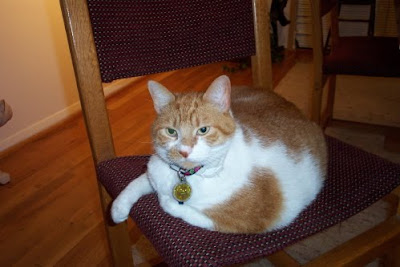
I posted yesterday about taking my daughter Louisa's old cat Clifford to the vet to be put to sleep and about how hard that was for all of us. Here he is in better days, sitting in our dining room on a favored chair. The trouble with falling in love is eventually every relationship you have has to end. Yet who would want to live a life without loves both large and small in it? Why have humans always made some sort of art? Everywhere you go, any continent, any century you sooner or later just trip over the stuff. Fortunately some of it is pretty good and every now and then you'll see something from another time that just takes your breath away. A good Rembrandt can do that for me. Rembrandt was a man who experienced serious losses in his life. There's not much written record of what he said about art or living. Nonetheless he has a lot to say to us. Here's a favorite of mine, one of his paintings of a windmill. It's the very end of a sunset, a time when the light is ...

An Argument in Art School

Image
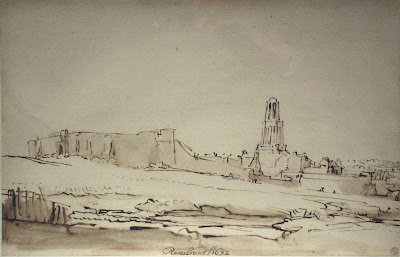
Following this Rembrandt ink wash landscape are three more of his amazing drawings. Back in the late 1960's I was a studio art major at Oberlin College. There were only three artists on the faculty, and of those only one could have been called an effective teacher and a good artist, Paul Arnold, a printmaker. I had the good fortune to be able to augment the limited art instruction. I spend the entire summers of '68 and - '69 living in New York City. I went to the art museums over and over again, my eyes drinking up all the delicious lessons on their walls. And I went full time to the Art Student's League of New York, one of the country's most venerable art schools. It was pretty good too. I made hundreds of drawings from the model and did my first figure paintings in oil. What was marvelous was for the first time I was around other art students with more experience than I had, and in some cases a desire equal to mine to plunge deep into painting and try hard make so...