Posts

Showing posts with the label drawing

Drawing and Painting Ogunquit, Maine

Image
Philip Koch, Narrow Cove, Ogunquit , oil on panel, 12 x 16 inches, 2021 Above is my new painting of the Maine shoreline just in front of the Ogunquit Museum of American Art. It was painted in my studio based on the on location vine charcoal I drew when my wife Alice visited the museum in October (see below). For decades I was painting outdoors with my oils and a French easel. Working like that brought a lot paintings I am proud of.  Just as important I learned so much about what it means to see creatively.  More recently I'm doing more painting in oil in the studio with the aid of vine charcoal drawings that I bring back indoors from outside excursions. Philip Koch, Narrow Cove Ogunquit, vine charcoal, 8 x 12 inches, 2021 For me the real purpose of making paintings of the outside world is that they invite us to explore our inner world. In a strong painting unusual shapes or unexpected chords of color will touch us down deep.  They awaken a language of energy and...
Finding a Roadmap

Image
Philip Koch, Morning at the Route 6, Eastham House, oil on  canvas, 30 x 60 inches, 2017, Swope Art Museum,  Terra Haute, IN For sometime I had wanted to make a painting of the farm buildings on Cape Cod that the painter Edward Hopper immortalized in his oil Route 6, Eastham that is at the Swope Art Museum  in Indiana. The source is right on the main highway that runs through the town of Eastham. Unlike the open space Hopper saw, it's now tightly ringed by evergreens. Edward Hopper, Route 6, Eastham, oil on canvas, 1941,  Swope Art Museum, Terra Haute, IN Much as Hopper has inspired me, I wanted to do a painting that would stand on its own, free from his long shadow. So instead of jumping right in I took more time than usual imagining different ways I might proceed. It required a balancing act, navigating my way between borrowing too much from Hopper and the need to deal with all those obstructing tree...

Which is More Important: Color or Drawing?

Image
      Philip Koch, Morning: Acadia, vine charcoal, 10 1/2 x 14", 2013 My title asked a trick question. One for which there is no answer. To me there's more connection than separation between drawing and painting. Drawing implies leaving a great deal of the surface of the paper exposed, while painting suggests covering over most or all of the ground of paper or canvas. I usually tell my painting students that "painting is mostly drawing," It is an exaggeration I know, but it does get their attention. The most magical thing about painting for me is of course color, as it is for most of us. But color is so powerfully fluid and multifaceted that it can easily elude us. A painting that is only about color would be like trying to get a drink in a parched desert without a cup.  You need a vessel.  Drawing in a great set of shapes "holds" the colors in place for your eyes to drink them in.  Shapes, and by that I mean the flat silhouettes that are the buil...

On the Pamet River

Image
Wanted to show you what I've been working on this week. Above is a new 9 x 12" oil on panel I did of the Pamet River up in Truro, MA on Cape Cod, about a half mile from Edward Hopper's old painting studio. I had done the vine charcoal below set up on the banks of the Pamet with my portable easel in 2010 on one of my 14 residencies in the Hopper studio. And as I often do I continued working on the drawing back in my studio as recently as last week. One of the reasons I paint from my drawings I've done out on location is it gives me one extra opportunity to distill down the dizzying complexity of the actual landscape. To stand outside with one's easel and look through experienced eyes at the landscape is to see too many possibilities. Even in the course of a few minutes the appearance of your source can change dramatically. And the longer you peer at the landscape you discover more and more contradictory statements you could make. If an experien...

Lost Edward Hopper Studio Drawing Found!

Image
After a four year on and off search I am delighted to report I finally found the vine charcoal drawing I did of Edward Hopper's  bedroom. It was done in his Truro, MA studio in Fall of 2006. To get this point of view my  portable easel had to be set up in the studio's kitchen.  My missing drawing had been lurking until this morning somewhere in my studio in Baltimore. It has been driving me slightly mad as I remember having really liked it but just couldn't put my hands on it (confession, alright, it was  just where I had left it, tucked in with some other early Hopper studio drawings behind a larger painting in my storage racks).  The drawing served as the basis of a couple of pastels and ultimately for this larger oil, Edward Hopper's Truro Studio Bedroom , oil on panel, 24 x 12", 2012. Hopper was no stranger to making drawings when he worked in this studio (there is a major exhibition in the offing at the Whitney Museum being orga...

A Tender Cradle

Image
One thing that's little understood by the public is how artists grow  their paintings. I often tell my students that when a good idea first comes to you it tip toes into your consciousness. Even for your best ideas it's more likely to whisper to you than shout. The trick is to give the idea water, nurturing, and patience until it's grown enough to stand on its own and let you work with it. The whole idea of drawing as a fine art in the Western tradition came from the artists of old gently rocking their ideas in the cradle. They made  working drawings. The great masters made drawings, usually lots of them, to figure out where they wanted to go before they did a painting. Drawing, a medium where one can more quickly erase and adjust than with oil pigments, was a perfect bridge between the great masters' imaginations and their finished paintings.  Above is my painting Equinox, oil on panel, 30 x 45". It came about from the fusion of several images I had b...

Looking Through Hopper's Window

Image
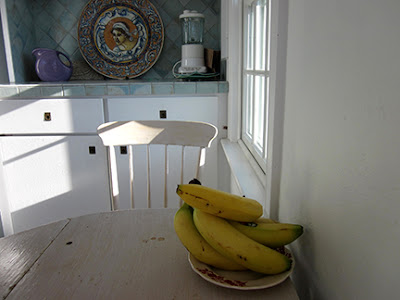
Here are a few more photos I took in Edward Hopper's S. Truro, MA studio this October when we were staying there during our 14th residency.  At the top is one of Hopper's kitchen table and chairs where he and his wife Jo would sit to eat. (We supplied the bananas). Below is a view from overhead of the same table that's flanked by two windows facing due east.  In the mornings this bright unobstructed light comes in through the two windows. It's delightful. Here is an 8 x 10" pastel drawing I did of the table from a similar viewpoint. Hopper did a number of powerful paintings of people seated around a table as in this early oil of his, Chop Suey from 1929, five years before he built the Truro studio. I love all the personality he expresses in the torsos of the two women. The one is front sculpted with flat angular planes, the one on the far side of the table with more rounded forms. Hopper is enjoying playing off extremely pale colors in...

Are Labrador Retrievers Good Art Teachers?

Image
Yes. I teach painting at a major art college in Baltimore. We have lots of very thoughtful discussions about    what makes for a good painting. Technique, process, vision, art history all get thoroughly chewed over. But underneath it all, I always find myself hoping that my students like dogs. When I was a kid everyone in my rural neighbor hood had a dog, sometimes two. The dogs all had a heck of a good time together having informal running contests or fighting over a stick. Sure they didn't think and reason a whole lot, but they all had PhD's in knowing how to enjoy whatever was at hand. Dogs seem to live in a world of sensation. Their ability to embrace their experience wholeheartedly is remarkable, and instructive. They know they're alive and they know their experience is worth celebrating. A big part of my life as a painter revolves around going on painting excursions in New England or the Adirondack Mountains in upper New York- traveling to ...

My 14th Residency in Edward Hopper's Cape Cod Studio

Image
I'm just returned from Hopper's studio in South Truro on Cape Cod. With the exception of one sunny day we had terrible weather but on the whole enjoyed a stellar time. For an artist like myself I can't imagine a greater honor than to stay in this studio that is just dripping with art history. Hopper's paintings speak to a lot of people. Hopper combined a remarkable openness to his surroundings with an almost maniacally rigorous selectivity. To put it another way, he saw more than most and chose only a tiny percentage of his perceptions as material good enough to make his art. For example this photo of the spot where Hopper spent half of each year for three decades might look to many artists like a perfect source to do sweeping deep spaced beach panoramas. But instead Hopper's imagination was usually more stirred by interior spaces, architecture, and a human presence.  The above photo was taken last week standing about 1/3 of the way down the path Hopper...

Drawings With Rembrandt on my Mind

Image
Philip Koch,  Summer, sepia ink, 31 x 41 1/2" At age eighteen I made the decision to become an artist. Blame it on an art history survey class I took my first semester at Oberlin College in 1966. I hadn't taken an art class since the summer between 7th and 8th grade, so my drawing skills were largely undeveloped. No matter, as my teachers in my first studio art classes at best gave lip service to traditional drawing, but really pushed abstraction and conceptual art. This wasn't all bad as it let me jump into the pool without feeling bad. One teacher went so far as to tell me "Drawing has been done. We artists have new tasks nowadays." For someone with few skills, this was a tempting philosophy. I painted abstractions with acrylic pigments for my first two years, as that was what everyone did in the Art Department. Actually, I learned a lot in the process about color mixing, the qualities of paint handling, how to make different kinds of edges, and s...