Posts

Mining the Burchfield Archives

Image
Charles Burchfield, drawing (undated)  panoramic view of  Gardenville, NY Catholic church steeple, Burchfield Penney Art Center, Buffalo, NY Charles Burchfield's expressiveness grew out of his highly-trained eye.  I am convinced his life-long habit of making drawings, lots of them, sharpened his remarkable imagination. He knew his art depended on an empathetic responsiveness and a finely-tuned selectivity. By making drawings he strengthened these attributes. His 20,000+ drawings  at the  Burchfield Penney Art Center  (BPAC) attest to the seriousness he attached to his task. Philip Koch,   Gardenville, NY,  vine charcoal, 9 x 12 inches, 2015 This is the same church Burchfield drew in the illustration at the  beginning of this post. Ironically it was the fist artwork I made  when I began my Residency at BPAC. The vast majority of his drawings in the Archives are quick studies, often done in...

Thomas Cole Drawing at Princeton & Burchfield Drawings in Buffalo

Image
- Last weekend I did some time traveling.  Or so it seemed.  I took a trip with the Baltimore Museum of Art 's Prints, Drawings and Photographs Society to the Princeton University Art Museum . Upon entering the Museum's galleries I fell almost immediately into an unassuming drawing by one of the great old masters of American painting, Thomas Cole (1801-1848), the founder of the Hudson River School of landscape painters. Titled simply Rocks, Trees, and Dog, Cole made it out probably while out on one of his nature hikes in 1846, just two years before his untimely death.  As I looked at it I had the sensation that old as it was, it could have been drawn by Charles Burchfield (Am. 1893- 1967) whose drawings I've been studying the last couple of years in the Archives at the Burchfield Penney Art Center in Buffalo, NY.  Modest as Cole's drawing is in scale, it has a lot to say-playing eloquently with themes of solidity and permanence v.s. forms ...

Did Charles Burchfield Lie About Color?

Image
When you've grown up in Western New York State as I did you know Spring comes late. Down here in Baltimore all our leaves have fully sprung forth for the year. It's downright green  everywhere. As I was driving yesterday I got to musing about this superabundance of the color green for us landscape painters. Nature's green hues are great for enabling photosynthesis. But the blunt truth for artists is it is almost impossible to paint the colors you see in the forest truthfully and end up with a painting with any life to it.  Burchfield Penney Art Center just this morning posted the above Charles Burchfield watercolor,  Maytime in the Woods , 40 x 33 inches, 1948-1963 on their Facebook page. It's one heck of a stunning painting.  Seeing it forcefully reminded me of how realist painters, including Charles Burchfield, have to make art that talks about the internal experience. We can't simply report on the literal facts of what we have...

Seven Things Charles Burchfield Wants You to Know

Image
A deeply thoughtful man, Charles Burchfield, through the example he set with his studio practice, had a lot to say. This is on my mind as next month I'll be returning to spend another week in Buffalo, NY as part of my Burchfield Residency at the Burchfield Penney Art Center. I thought it would be useful to summarize some of what I've learned from this artist.  Here goes: 1. Value where you are. Trust that there is meaning in your immediate surroundings. Burchfield realized after only a brief stay in New York City that his creativity had always been most stimulated by close proximity to nature. The big city for him would have been a bad career move. 2. Prepare yourself for insight. He was constantly studying the world through the thousands of drawings he left us. When he got a good new idea it found its way onto drawing paper fast. 3.  Be patient.  He knew often brilliance comes to us only slowly. There's no better example than Burchfield of a painter wil...

Mansard Roofs I Have Loved

Image
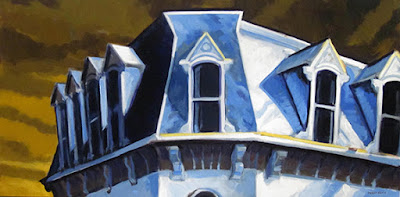
Philip Koch, Mansard Roof, oil on canvas, 22 x 44 inches, 2017 Last Thursday evening I put the final touches on my latest painting (above). Then on Friday morning I viewed an Edward Hopper painting in the Philadelphia Museum of Art's American Watercolor in the Age of Homer and Sargent  exhibition that reminded me how Hopper's influence has often steered me in my choices of what to paint.  When I was a kid I'd see these mansard roofs in the old sections of downtown Rochester, NY and wondered about them- they seemed radically different than the California-modern house I was growing up in. To my young eyes they were unfathomably old and mysteriously exotic. But even then I had to admit they created a more striking silhouette against the sky than more ordinary buildings. My painting stemmed from some drawings I made on location in Buffalo, NY as part of my being Artist in Residence at Burchfield Penney Art Center (BPAC). Tullis Johnson, one...

The Vanishing Sand Dune- Edward Hopper and Me

Image
Philip Koch, From the Camel's Hump, oil on canvas, 42 x 72  inches, 1983, private collection I painted this large oil from a small plein air painting I made during my very first stay in Edward Hopper's former studio in S. Truro, MA.  The view is looking south at a panorama of Cape Cod Bay. The light is just after dawn. In the foreground is a strange feature- it's the hole in the ground where the distinctive dune pictured below once rose up. It was something of a landmark in Truro, known as the Camel's Hump. Edward Hopper, The Camel's Hump , oil on canvas, 1931 Munson Williams Proctor Arts Institute, Utica, NY That natural feature caught Hopper's eye during the second summer he and his wife Jo stayed on the Cape. He waited until the late afternoon's slanting light emphasized the dunes impressive volumes. To my eye it is one of his finest paintings and a keystone of the Permanent Collection of the Munson Williams Proctor Arts ...

Saved from a Cloud of Stinging Beasts!

Image
Philip Koch,  Dune at Paine Hollow, oil on panel, 13 x 26 inches, 1984 There is a very funny story associated with this oil. I was up on Cape Cod in June of 1984 painting in the Paine Hollow area of S. Wellfleet, working from a tidal inlet off of Cape Cod Bay. Things were going well for the first hour or so when the wind shifted and a cloud of tiny black flies descended on me. I toughed it out for another 10 minutes but the swarm overwhelmed me and I raced back to the car with my painting. When I got back to the rental cottage I looked in horror at the wet painting’s surface which was covered with the tiny bodies of the insects. I asked my daughters if they’d like the job of removing the bugs if I paid them a penny for each insect. They were young enough that to them this was serious money. Armed with palette knives they began meticulously picking off the critters. They were taking their task very seriously so I left them to it and took a shower to get the remaining...