Posts

Three Things Edward Hopper Wants You to Know

Image
Here's a painting the young Edward Hopper made in art school. Tomorrow I begin teaching my final class at MICA before moving on to being a full-time painter. Fittingly my class is Life Drawing class.  Probably I'll begin the class by showing the students this painting. In Hopper's oil above we can see him working to master the basic grammar that would serve him so well in his ensuing years of painting. His painting from the model offers us a host of lessons about about painting and about seeing itself.  Here are three that I think are among the most important. 1. Color in reality is more unexpected than we think. The pinks and subtle oranges we imagine we're going to see in the model's skin are shown instead in a world of cool grays and gray-greens. Hopper sees her color as part of the overall mood of the light in the room. 2. Hopper walked around for awhile before starting his painting to check out all the possible vantage points. It's not the normal...

Brandywine River Museum of Art- N.C. Wyeth Exhibition

Image
N. C. Wyeth, Blubber Island, Port Clyde, Maine, tempera and oil on hardboard, 1944, Brandywine River Museum of Art N. C. Wyeth: New Perspectives, organized by the Brandywine River Museum of Art and the Portland Museum of Art (in Maine) is on display at the Brandywine Museum through Sept. 15. It heads up to Portland Oct. 4, 2019 through Jan. 12, 2020. My wife Alice and I drove up to see the exhibition last Friday. In a word it's super. Sometimes we head into a show intending to spend more or less equal time with all the works. That didn't happen as I totally fell into the first two paintings I saw as soon as I entered the gallery. First is the one above of a solemn rocky island adorned by a device the wall label identifies as a hydrographic signal. That signal lifts our eye up from the heavy mass of the rocks and gets us to look into the sky.  At first I wondered why the signal and the several seagulls flying off to the left felt so right. Then I rea...

The Rhythm of the Studio

Image
One of the mysterious truths of making art is an artist has to discover the working methods that click with their particular brand of creativity.  You have to try just about everything until you stumble upon what is going to work best for you. Above is a photo of my studio this morning. At the left is the blocked-in foundation coat of paint for my new 36 x 54 inch canvas that's based on a smaller composition I made earlier this year Beneath the Pine  (that I wrote about in the previous blog post ). It's an unusually detailed first coat of paint for me. It took many hours of staring and mixing.  At this point I am putting the new painting aside for a few days. My excuse can be I want to let it dry thoroughly before plunging back into it, which sounds all good and rational. But the real reason is more an "absence makes the heart grow fonder" phenomenon. I need to refresh my thinking and my eyes for the painting.  Leaning against my other easel o...

Growing Art Takes Time

Image
Once when she was little I was showing my one of my daughters how I make my big paintings by building up layer upon layer of paint until I get the colors to behave just right. She asked "why don't you just paint the right color the first time? Then you'd be done real fast." This is a detail of the 36 x 54 inch canvas I'm working on on my easel right now. It's based on the smaller oil below, Beneath the Pine,  19 x 28 inches, 2019 (at Courthouse Gallery Fine Art   in Ellsworth, ME). At this early blocking-in stage the painting has a flat look. But I'm just getting the lay of the land. Later on I'll be going back over 99% of its surface and repainting each area to give it a fine tuning. Some areas will need to be painted over 3 (or more) times to get them to behave properly. I work with oil pigments in a wet-into-wet method that's made possible by the paint's slow drying time. Sometimes two adjacent colors need to contrast e...

Pennsylvania Academy's Schuylkill to the Hudson Exhibition part 2

Image
John Frederick Kensett, Hill Valley, Sunrise , oil on canvas, 1851 Last Friday my wife and I had a personal tour from Curator Anna Marley of the major exhibition she organized, From the Schuylkill to the Hudson: Landscapes of the Early American Republic , at the Pennsylvania Academy of the Fine Arts. I wrote a previous post about the the show's first pioneers of the American landscape painting movement. Their works were centered in Philadelphia, preceding the better known Hudson River School. This is a look at some favorites by later Hudson River School artists.  The John Kensett oil above is a masterpiece of seeing. Kensett is renowned for his diaphanous brushwork. But he corrals his strokes into solid cohesive shapes with inventive silhouettes. Our eye gets a wild ride tracing the outline of the tops of his trees at the left and over the lines of the mountain ridges at the right. Our responses to art are highly subjective, including mine. I know on...

Major Landscape Exhibition at Pennsylvania Academy of the Fine Arts / Part One

Image
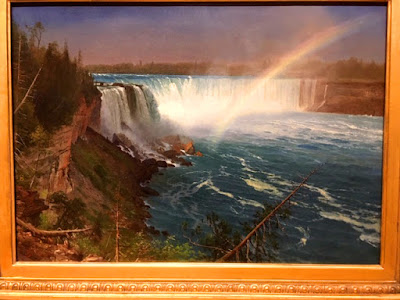
Albert Bierstadt, Niagara, oil on paper laid down on canvas, 1869 One of the things that sustains me as a landscape painter is understanding I am part of an historic movement of artists who took delight in our planet. Each generation of landscape painters adds their own contemporary voice to a chain of paintings stretching back hundreds of years. Especially in our time of impending climate crisis reigniting the deep strain of environmental sentiment that runs all through American landscape art is part of my personal mission. This week Anna Marley, the Curator of Historic American Art at the Pennsylvania Academy of the Fine Arts in Philadelphia, very kindly gave me and my wife a personal tour of her major exhibition From the Schuylkill to the Hudson: Landscapes of the Early American Republic  shining a light on the earlier beginnings of landscape painting our country. Contrary to the usual understanding, Marley shows the much better known...

Seeds from the Past

Image
Philip Koch, Late Autumn Sun, oil on canvas, 36 x 48 inches 2019 Here's one of my recent paintings. Just yesterday I was redoing the final varnish coat to give it the smooth and continuous skin that I love to see on a painting. I lay on the varnish very carefully using a smaller brush than I have to so I can keep the thickness I'm applying completely uniform. It takes longer doing it this way. Often it lulls me into a contemplative frame of mind. I found myself drifting back to the first summer I took my oils outdoors to paint from the landscape. It was at the end of my first year of the MFA Painting program at Indiana University. I had spent that year experimenting with all sorts of surreal looking approaches to making paintings about "the look of the world." I had relied solely on my imagination to make them but was feeling some extra note of authenticity had been missing. But June beckoned full force and I found myself out searching for panorama...