Posts

Showing posts with the label art history

Brilliant Sun on Barren Hills / Echoes of an Edward Hopper Painting

Image
Edward Hopper, Mrs. Scott's House, oil on canvas, 34 1/4 x 50 1/8 inches, 1932, Maier  Museum of Art at Randolph College, Lynchburg, VA I don't usually start a painting with another artist's painting in mind. My new canvas below however owes a big debt to Hopper's oil Mrs. Scott's House  that's in the collection of the Maier Museum of Art at Randolph College in Lynchburg, VA. Edward Hopper and his wife Josephine first stayed on Cape Cod in the summer of 1930. For the next several summers they explored the land out near the very end of Cape Cod's peninsula.  Famously private, I suspect he liked how few people there were in the remote town of Truro.  One striking painting that resulted from this searching was Mrs. Scott's House  seen above.  Hopper was always drawn to paint big, solid volumes illuminated by brilliant sunlight. He must have loved the stark contrast of the massive and nearly bare dunes against the small but stubbornly u...
Major Landscape Exhibition at Pennsylvania Academy of the Fine Arts / Part One

Image
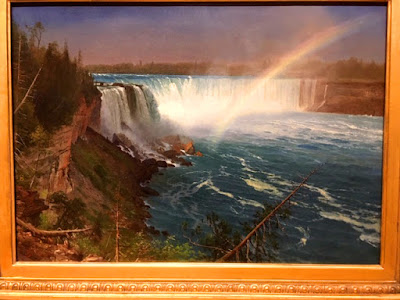
Albert Bierstadt, Niagara, oil on paper laid down on canvas, 1869 One of the things that sustains me as a landscape painter is understanding I am part of an historic movement of artists who took delight in our planet. Each generation of landscape painters adds their own contemporary voice to a chain of paintings stretching back hundreds of years. Especially in our time of impending climate crisis reigniting the deep strain of environmental sentiment that runs all through American landscape art is part of my personal mission. This week Anna Marley, the Curator of Historic American Art at the Pennsylvania Academy of the Fine Arts in Philadelphia, very kindly gave me and my wife a personal tour of her major exhibition From the Schuylkill to the Hudson: Landscapes of the Early American Republic  shining a light on the earlier beginnings of landscape painting our country. Contrary to the usual understanding, Marley shows the much better known...

Paintings That Shouldn't Work But Do: Burchfield

Image
An artist friend, Anne McGurk, who I've never met in person but who's got a heck of a good eye for paintings (disclaimer, she owns one of my oils, proving right there she has an elite sensibility) has put together an album of work by the American painter Charles Burchfield (1893-1967) that is just a hoot. I have to recommend it to you- here's the link. It's got lots of images that I've never seen before along with old favorites. Burchfield is one of those painters who defies being put into an easy category. He draws from America's long tradition of romantic nature painting (Hudson River School, Martin Johnson Heade), adds in an enthusiasm for modernist shallow spaces, and seasons the whole thing with what I can only call a psychedelic inner spice. In other words, he doesn't look like anybody else. Burchfield has a knack for making paintings that break all sorts of rules of "serious" painting but somehow manage to work successfully anyway. ...

A Tender Cradle

Image
One thing that's little understood by the public is how artists grow  their paintings. I often tell my students that when a good idea first comes to you it tip toes into your consciousness. Even for your best ideas it's more likely to whisper to you than shout. The trick is to give the idea water, nurturing, and patience until it's grown enough to stand on its own and let you work with it. The whole idea of drawing as a fine art in the Western tradition came from the artists of old gently rocking their ideas in the cradle. They made  working drawings. The great masters made drawings, usually lots of them, to figure out where they wanted to go before they did a painting. Drawing, a medium where one can more quickly erase and adjust than with oil pigments, was a perfect bridge between the great masters' imaginations and their finished paintings.  Above is my painting Equinox, oil on panel, 30 x 45". It came about from the fusion of several images I had b...

Dark Beauty- George Ault

Image
This night painting of a snow covered barn is by the lesser known American artist George Ault (1891-1948). Ault is an intriguing counterpoint to his contemporary Edward Hopper. Here's Hopper painting a similar barn with an enormously different expressive intent.  So many claim Hopper always painted lonliness, but compared to Ault Hopper feels downright ebullient  Ault was born into a wealthy family in Cleveland (which I get a kick out of as I once briefly attended the Cleveland Institute of Art). He studied painting in London and returned to the U.S. Apparently he succumbed to alcoholism and alienated those around him. He found his paintings very difficult to sell. His three brothers all committed suicide. Ault is thought to have eventually drowned himself. Pretty bleak scenario. Nonetheless, he could produce some solemnly moving nocturns. Despite his saturnine outlook he still managed to find delight in the mysterious geometry he found in the world,...

A Discovery About The Cleveland Museum of Art's Edward Hopper

Image
Aha!  In this oil Hopper painted the very spot where he would build his famous studio on Cape Cod. It's a sort of painted love letter to where he and his wife Jo would spend half of each year for the last three decades of their lives.  The painting is   Hills, South Truro  from 1930 that's in the Collection of the Cleveland Museum of Art (the first art museum with a truly world class collection that I visited regularly once I'd discovered it as a budding art major at Oberlin College back in the late '60's).  Earlier this month when I was sitting in Edward Hopper's studio on Cape Cod I took a break from the paintings I was doing and absentmindedly began flipping through a book of plates of Hopper's work. As Hills, South Truro  came into view it hit me that I was literally sitting right in the middle that painting. I've always thought it one of Hopper's masterpieces, and the one that comes closest to capturing the slightly other-wo...

Painting the Connecticut Coast

Image
Last week I was up in Connecticut for the grand opening reception for the Art Essex Gallery  where nine of my oil paintings are hung in their inaugural exhibition. While there I did some painting right down on the water in East Haven, CT where the Farm river flows in to Long Island Sound. My old fried Bob Wetmore who I've known since elementary school days has a place right on the River. It's got amazing views. Above is Connecticut Shore,  oil on panel, 8 x 16", 2012.  The view is looking due east with Long Island Sound's open waters off to your right. This Connecticut low country played a big role in American art history- for example the American Impressionist landscape painters who gathered in Old Lyme. But for me this is special territory more for the work John Frederick Kensett (American 1816- 1872) who created some of the most amazing paintings from the 19th century of the shoreline of Connecticut and neighboring Rhode Island.  When I first started l...

George Bellows at the National Gallery of Art

Image
Yesterday my wife Alice and I drove down to Washington, DC to the National Gallery of Art to see their huge George Bellows (American 1882 - 1925) show of paintings (through Oct. 8, 2012).  Bellows was a school mate of two of my favorite artists- Edward Hopper and Rockwell Kent (both also born in 1882- obviously a great year to grow new artists) at the New York School of Art. All three showed a marked influence from their teacher, the charismatic Robert Henri, whose work was characterized by rapid execution with large brushes and a high sense of pictorial drama. Kent and Hopper gradually moved more away from Henri's style and vision as the years went by, but Bellows seemed to find a more comfortable fit  and stayed with the swashbuckling application.  I've always been a fan of Bellows' paintings but was still surprised at how much impact most of his work had. Some of my favorites were his early landscapes from New York done along the Hudson River and the East ...

Peter Trippi, Allentown Art Museum, and The Lady of Shalott

Image
Sunday I drove up to Pennsylvania to hear a talk by Peter Trippi at the Allentown Art Museum . The Museum has an impressive exhibition up now of fantasy and science fiction art, At the Edge (through Sept. 9). Allentown Art Museum is delightful- it's recently completed an expansion and has a wonderful permanent collection. If you're near eastern Pennsylvania try to visit. We forget that current fantasy art is just the latest installment in a long tradition. Peter Trippi's talk provided background on this movement by looking at fantasy painting in 19th century Britain. As Trippi showed, there was lots of it, much of it first rate. Trippi is the Editor of one of my favorite magazines, Fine Art Connoisseur ,  that champions the continuing vitality of the realist tradition in painting. He for several years was Director of the Dahesh Museum in NYC. And he is an expert on the work of JW Waterhouse, a late 19th century British painter, and the author of a great book on ...