Posts

Showing posts with the label technique

The Rhythm of the Studio

Image
One of the mysterious truths of making art is an artist has to discover the working methods that click with their particular brand of creativity.  You have to try just about everything until you stumble upon what is going to work best for you. Above is a photo of my studio this morning. At the left is the blocked-in foundation coat of paint for my new 36 x 54 inch canvas that's based on a smaller composition I made earlier this year Beneath the Pine  (that I wrote about in the previous blog post ). It's an unusually detailed first coat of paint for me. It took many hours of staring and mixing.  At this point I am putting the new painting aside for a few days. My excuse can be I want to let it dry thoroughly before plunging back into it, which sounds all good and rational. But the real reason is more an "absence makes the heart grow fonder" phenomenon. I need to refresh my thinking and my eyes for the painting.  Leaning against my other easel o...
A Cure for Impatience- Drawing

Image
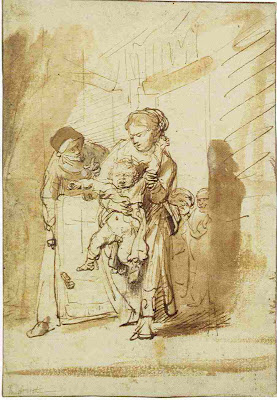
Here's an ink wash drawing by Rembrandt. Almost 400 years since the guy drew it and it still has things to tell us. Look at the elegant anatomical precision of the woman's head at the left! (you can click on the image for a larger version). Actually I'm pulling your leg. That head isn't particularly well drawn. But therein lies much of what is so good about this drawing. Rembrandt was using this drawing to help him discover what it was in this scene that he was most genuinely interested in. Instead of a polished finish we get the feeling the artist is groping his way forward. Initially he's not sure exactly what he's after.  He uses the time spent making this drawing to slow himself  down and sift through the possibilities. It's funny as one would think one knows what one likes. Yet art shows us our first answer may not be the best answer.  So often a piece of art fails because the artist tries to do everything and ends up accomplishing very little. Remb...

Painting in the Washington County Museum of Fine Arts

Image
Last week Amy Hunt who runs the Education program at the Washington County Museum of Fine Arts in Hagerstown, Maryland invited me to set up my easels and work in the Museum's galleries for a day. This was to be part of Hagerstown's Artwalk , a coordinated day of artists, musicians and poets performing throughout the city. My first response was hesitant. I've never done a painting demonstration where a group watches as I create a painting and talk about what I'm doing as I work. Honestly I find painting hard enough to do well as it is without worrying about being entertaining or educational as I do it. But as I thought more about it, I reconsidered. This was an opportunity to use the Museum and its unique ambiance as a studio for a day. Now there are times in the creative process that are especially critical- the times when you're just beginning to inch your way forward in unfamiliar territory. It can be a little like walking on egg shells. Sometimes you need comple...

Big Ed Again

Image
When your first impression of an artist comes from looking at reproductions in art books or images on a computer, you can get the sense the artist was flawless. Hints of the struggle the artist had with the piece can be hidden by the photograph. And you can come away with the sense the artist's feet don't really touch the ground. But as a veteran painter, I assure you they do. Completing a painting is a little like scaling a mountain. You get to the top by a circuitous route and you take a lot of steps. Here's an early Edward Hopper oil, Sailing, I have always loved. Some years ago I was in Pittsburgh and got to see it in person at the Carnegie Art Museum. As I stood looking at it, I was annoyed by random bumps in the pigment in the sky. Then I realized what I was seeing- if one squinted one's eyes you could just make out a human head underneath the sky and sail. Hopper had recycled one of his early canvases. It had been a vertical portrait study he'd done that ha...

Mixing It Up

Image
Philip Koch, The Sentinel, oil on panel, 28 x 42", 2010 I wanted to show you a little of my working process. Above and just below are two paintings I was working on just this morning. The Sentinel was begun a number of years ago from direct observation out in the town of Tomball, Texas (you may think I'm joking but I actually chose the location based on its name when I was looking at a map of the state. I confess my love of cats, including males, swayed me). I've moved back into the studio to finish the painting. These days most of my moves come either from memory or my imagination. What I'm aiming at is a kind of painting that exists just a bit beyond the ordinary, as if perhaps I'm showing you the landscape as it might appear in one of your dreams. Philip Koch, Northern Sky, oil on panel, 7 x 10 1/2", 2010 You'll notice the two paintings are radically different sizes. Northern Sky was completely invented in the studio with me imaging the a reverie of th...

Voyage

Image
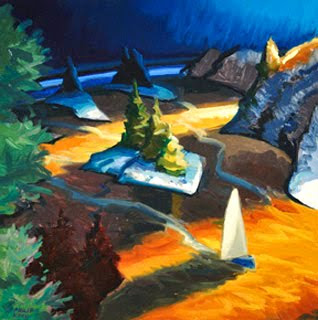
Philip Koch, The Voyage, oil, 18 x 18" This is a small painting I made in preparation for a major studio oil. It's in a group exhibition Waterscapes at the Nichols Gallery in Barboursville, VA right now. I was looking at it on their website and really enjoyed seeing it again. It is I feel, an original painting. This is an invented painting in the sense I dreamed everything up. But every aspect of it depended on the hours I've spent looking at boats, bays and shores, things that were prominent in my young life. And equally dependent on pouring over some work from artists who've gone before me. I actually had an autobiographical idea in mind when I first started cooking this painting up. An image from my childhood that always stays with me is the little single sail cat boat my father bought when I was about eight. He took me sailing often and taught me how to navigate the thing on Lake Ontario. He was a slightly reclusive and profoundly taciturn man, and wasn't the...

Looking Out, Looking In

Image
Here I am in Acadia National Park in Maine getting ready to paint. I'm surveying the horizon to decide just what to include in the next picture. And this is what greeted me this morning as I entered my studio. The night before I had been sorting out some oils on paper, deciding which to use as sources for new paintings. These two photos reveal a lot about the creative process. First you go out and encounter the world. There's looking long and hard, and then mulling over what you've seen to pull out what's most significant. It's like human relationships- you meet hundreds and hundreds of people. You end up having something meaningful with only a handful of them. If you're lucky you've picked wisely and reap the benefits. For a landscape painter, being outside is exhilarating but a little overwhelming too. It pours over you. But you make paintings and drawings out on location, catching what you can of the best ideas you find out there. I love to bring the smal...

The Coolest Painting in the Philadelphia Museum of Art Explained

Image
Sanford Gifford, A Coming Storm, oil, painted during the Civil War My wife Alice took off from her job at the mental hospital yesterday and drove up to Philadelphia with me (actually she did most of the driving, but as women statistically are safer drivers than men, this is as it should be). We were headed to the Philadelphia Museum of Art which since it's in such an old city and got a head start on building its collection has almost an embarrassment of riches. It's one of those museums where there's too much to look at closely. We took in the Late Renoir show, which impressed me a lot. Renoir was terrific at paint handling. Unfortunately they don't like you to photograph temporary exhibits where they've borrowed work (I suspect mean-spirited Dobermans are ready to be unleashed at a moment's notice on anyone who tries it). But no matter, as their permanent collection galleries are brimming with great stuff. As a kindness, I thought I'd talk about the best...

The "Nature" of Art

Image
Went over to the Eastern Shore of Maryland on Friday and stopped in at one my favorite museums, the Academy Art Museum in Easton, MD. Here's a picture of its main entrance. I'm not sure what the original building was built to be (meeting hall, church, school?), but its conversion to an art museum was beautifully done. I love the classy silhouettes of the old building. Hey, why shouldn't art come in an attractive package? One thing I like to do some of the time is to look at art that is outside my usual realm. Brian Young, the Museum's Curator was giving a talk that afternoon on the Museum's recently acquired gift of 50 pieces of primarily minimal and conceptual art from the Vogel Collection. Brian is a real enthusiast for this branch of the tree of modern art, so I wanted to hear some of his stories about the art and how it found its way to the AAM. It is a very good thing to listen to people who have different ideas than the ones you hold. It shakes you up and fres...

Lessons in Restraint from Edward Hopper

Image
Here's an oil by the famous 2oth century American painter Edward Hopper, Road in Maine. Hopper was a bold painter, famous for his strong lights and shadows. But his genius more often lay in how he held back from high contrasts. Just as you need silence to appreciate a loud noise, you need quiet passages to let the drama that is there have a weighty impact. Here are some examples of Hopper's elegant restraint. First, it's a mostly yellow painting (though in the form of yellow ochre-greens). The sky has blue in it, but not that much. Hopper has held back on the amount and intensity of his blue to keep the emphasis on the ground. The blues in the sky are knocked back into a subordinate role. I can't tell you how many times I've seen less experienced landscape painters paint vibrantly colorful skies that compete with the ground they've painted. Here Hopper says he wants you to look at the ground. He gives us two hillsides and a valley. Look at the top edges of both...

The Secret Power of the Artist Playing the Curator

Image
I concluded my discussion of three roles of the artist advising the artist to wear the Curator's hat. Any artist who's been at it more than a few years tends to take really good care of their work. Above is a photo of the four paintings I wrapped up in bubble wrap yesterday in preparation for their trip up today to Isalos Fine Art in Stonington, Maine. I wanted to make sure they arrive in mint condition so I make an overly sturdy box and then carefully wrap each piece so it can't wiggle around during the trip and get nasty scratches anywhere. I learned all this the hard way. Below is a picture of my flat file where I store work on paper that hasn't been framed yet. I purposely keep it out of my basement, which has been attacked by the water gods several times in the last fifteen years I've lived here. (I also run a dehumidifier in the basement 6 months a year to keep the paintings stored down there dry and toasty). I've a unique vantage point as an art instructo...

Part III- Curator

Image
Philip Koch, Memorial II, oil on panel, 6 1/2 x 13", 2010 Philip Koch, Edward Hopper's Rooms by the Sea, oil on panel, 5 x 7 1/2", 1991, repainted 2010 I'v said there are three roles for the successful artist to master- Explorer, Magician-Builder, and Curator. The Curator is the part of you that is the caretaker of your work. There is a physical side to this that I'll be returning to later. Tellingly "Curator" comes from the same Latin root as the verb "to cure." As an artist you are the Curator of your vision. Likely as not it appears to you at first in bits and pieces. You gather them up, dust them off, and fit them together as best you can. Gradually you assemble them into something you can rightly call a vision. Making a painting is like making fine wine. It grows at its own pace and comes fully into season only when it's good and ready. Usually it takes way longer than one would like. A very big part of playing the Curator is to deve...