Posts

A Tender Cradle

Image
One thing that's little understood by the public is how artists grow  their paintings. I often tell my students that when a good idea first comes to you it tip toes into your consciousness. Even for your best ideas it's more likely to whisper to you than shout. The trick is to give the idea water, nurturing, and patience until it's grown enough to stand on its own and let you work with it. The whole idea of drawing as a fine art in the Western tradition came from the artists of old gently rocking their ideas in the cradle. They made  working drawings. The great masters made drawings, usually lots of them, to figure out where they wanted to go before they did a painting. Drawing, a medium where one can more quickly erase and adjust than with oil pigments, was a perfect bridge between the great masters' imaginations and their finished paintings.  Above is my painting Equinox, oil on panel, 30 x 45". It came about from the fusion of several images I had b...

Dark Beauty- George Ault

Image
This night painting of a snow covered barn is by the lesser known American artist George Ault (1891-1948). Ault is an intriguing counterpoint to his contemporary Edward Hopper. Here's Hopper painting a similar barn with an enormously different expressive intent.  So many claim Hopper always painted lonliness, but compared to Ault Hopper feels downright ebullient  Ault was born into a wealthy family in Cleveland (which I get a kick out of as I once briefly attended the Cleveland Institute of Art). He studied painting in London and returned to the U.S. Apparently he succumbed to alcoholism and alienated those around him. He found his paintings very difficult to sell. His three brothers all committed suicide. Ault is thought to have eventually drowned himself. Pretty bleak scenario. Nonetheless, he could produce some solemnly moving nocturns. Despite his saturnine outlook he still managed to find delight in the mysterious geometry he found in the world,...

Ghosts

Image
Almost exactly a year ago I was headed out to Michigan for the opening of my traveling exhibition Unbroken Thread  at the Saginaw Art Museum. The show had been organized by the University of Maryland University College and traveled to eight art museums and art centers around the country from 2008-2012. When I arrived at the Saginaw Museum I was delighted to find the curator had hung along side my work some paintings from the museum's Permanent Collection to establish some historical background. Two pieces were by an artist I wasn't familiar with, Charles Warren Eaton (American 1857-1937). Here are two other of Eaton's oils. I find them very beautiful. And they're kind of radical in the way they force the issue of large flattened out silhouettes being the focal point of the painting. Both paintings  here are of pine trees. But as for the composition and energy of the big flat shapes it's hard to image them being more different from each other. ...

Looking Through Hopper's Window

Image
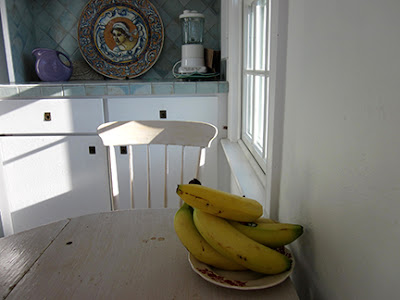
Here are a few more photos I took in Edward Hopper's S. Truro, MA studio this October when we were staying there during our 14th residency.  At the top is one of Hopper's kitchen table and chairs where he and his wife Jo would sit to eat. (We supplied the bananas). Below is a view from overhead of the same table that's flanked by two windows facing due east.  In the mornings this bright unobstructed light comes in through the two windows. It's delightful. Here is an 8 x 10" pastel drawing I did of the table from a similar viewpoint. Hopper did a number of powerful paintings of people seated around a table as in this early oil of his, Chop Suey from 1929, five years before he built the Truro studio. I love all the personality he expresses in the torsos of the two women. The one is front sculpted with flat angular planes, the one on the far side of the table with more rounded forms. Hopper is enjoying playing off extremely pale colors in...

The Tricky Balance of Contemporary Art

Image
Philip Koch, Sun in an Empty Room III,  oil on panel, 12 x 9", 2012 To anyone who tries to follow contemporary art I want to say I understand why you feel confused. If it's true that art holds a mirror up to life, isn't this pretty much to be expected? Almost everyone I know is glad to be here. But that said, they're bewildered by living much of the time. "Contemporary Art" isn't a style. It just means art that has been made today. If used properly, the term extends all the way from performance art using digital video projections to work made by artists who think everything that happened after the 19th century French painter Ingres stinks. I have two observations. There has been an explosion in the number of possible ways artists can make art. A young student at my art school in Baltimore is expected to have at least familiarity with the following: digital art, video art. performance, inst...

More Edward Hopper Studio Photos

Image
Wanted to show some more of the photos from the most recent residency in Hopper's S. Truro studio on Cape Cod in Sept. and Oct. Above is the studio seen just as the first sun of the day is beginning to hit its opposite side, This photo give you a sense of how Hopper carefully chose the spot for his studio, placing it on one of the more exposed high places on the ridge of sand dunes that run along the shore of Cape Cod Bay. He obviously wanted great unobstructed views.  The studio has as many windows as the construction methods of his day commonly allowed. It literally catches the first and the very last rays of the day's sunlight. I think of it as his "observatory" where he spent years absorbing and studying the effects of sunlight. It shows in his paintings with their remarkable power to evoke the feel of strong sun and elegant moody shadows. This is Hopper's kitchen in the afternoon sunlight that's coming in through the window on the kitch...

The Poetry of Sharp Branches

Image
Landscape painting has been with us in the western art tradition since the Baroque era. Around then painters started having more fun with the backgrounds. Previously the landscape had been relegated to only  a supporting role to prop up flattering paintings of the local nobleman or pious saints. These new landscape painters urged us to delight in the natural world. And they help us answer some big, pesky questions- Where did we come from? Where are we now? The best of their paintings are a forceful reminder that we are part of nature, and that it is in us, right at our very core.  Above is the 19th century German artist Caspar David Friedrich's Abby in the Snow , a painting that still gives me a little chill ever time  I see it. It's a masterpiece of gradating colors to create an almost supernatural glow to the sky. One of Friedrich's tricks is to push the darkness so forcefully into both his upper sky and into the low hanging mists on the horizon. It would ...