Posts

Guessing Where that Painting Was Painted

Image
Here's a painting I shipped north yesterday to Edgewater Gallery in Vermont for their Featured Artist show for December (Dec. 1- 31). There's a public reception Saturday Dec. 4 from 5 - 7 p.m. Any readers of this blog are especially welcome to come by and say hello. This one is Trees at Lake Conroe , oil on canvas, 42 x 28". Inevitably when people really respond to one of my paintings at an opening reception they come up to me a little excited and announce they know exactly the spot where the piece was painted. I'm always temped to tell them "You're right." Because in a real sense they are. Let me explain. A painting is a little like a springy trampoline for one's imagination and memory. In all of us both those capacities tend to get rusty and need to get provoked back into action. That's where the art part comes in. If my painting is really well painted it is saying something important to the viewer using the unique language of shapes and colo...

Dressing for Success with Winslow Homer!

Image
The longer I paint the more my eye focuses on how great painters presented their ideas rather than what they painted. Here are three wonderful paintings where the great 19th century American Winslow Homer gives our eyes some delightful fashion tips (OK, I'm kidding about the fashion tips part, but he does show us how inventive he can be in his paintings. Images courtesy Art Renewal Center). Let's take a look at what Homer can do with arranging his costumes to pump up the expressive volume. At the top is Homer's watercolor Early Evening . The two women at the right have the spiffiest aprons. Both women stand totally erect, and without their aprons blowing off to the left, they'd look like two telephone poles. Almost undoubtedly the diagonal sweep of the aprons was something Homer consciously inserted into his scene, knowing it would breath life into his women. It's a note of visual surprise. Without it, these two women wouldn't draw our attention the way they do....

Quick tour of new Koch exhibit in Baltimore

Image
Viewers often ask me about where a particular painting was done or what I was thinking about when I made it. A new show of my work and that of an abstract landscapist, Emily Demsky, opened in Baltimore yesterday at the JLP Gallery at Green Spring Station in Lutherville. It runs through Jan. 7, 2011. This Thursday night, November 11, there's an opening reception from 6-8 p.m. If you're in the area please come by and say hello. I thought it would be fun to give a quick tour of my oils in the show. This is Late Winter Sun, Roland Park . It's of a lovely older neighborhood at the north end of Baltimore. I painted this from life on a series of frigid January days. I'm standing in a shadow that runs across the whole foreground. While it was colder standing there, I liked that shadowed spot as it placed some cooler blues and violets in the front of the painting to contrast the warm colors in the distance. While I was working on this painting the front door of the house opened...

New Book on a Rediscovered Painter

Image
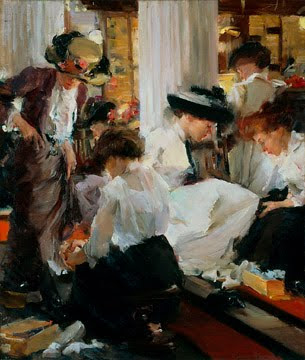
Isn't this an amazing bustling composition! It's by a painter known today by very few, but at the beginning of the 20th century the artist was widely considered one of the country's most promising rising stars. The above oil painting is Shoe Shop by Elizabeth Sparhawk-Jones (from the Permanent Collection of the Pennsylvania Academy of the Fine Arts, Philadelphia). An art critic writing in the New York Times reviewing a 1907 Pennsylvania Academy of the Fine Arts (PAFA) exhibition exclaimed Jones was "knocking at the door" and added that a work by her teacher, the legendary William Merritt Chase looked "tame and stilted by comparison with the jubilant performance of Miss Jones." (How that line must have burned good old Chase). I found that juicy review in the new book by an old friend of mine, Barbara Lehman Smith, who I met, of all places, in a step aerobics class at my gym some years ago. We're both still kicking, which goes to prove exercise is goo...

The Kent Collector Journal & How to Draw

Image
Marguerite Eisinger, the Editor of The Kent Collector journal kindly published my article in her new Fall/Winter 2010 issue. It's based on two posts I wrote on this blog last January as an appreciation of some of my favorite wood engravings by the 20th century American artist Rockwell Kent. If I was really organized I'd now have a spiffy link you could click that would bring up those two posts so the curious could read them. But I just raked up two tons of leaves out of my backyard and will make you go search for them yourself. The journal is published by one of the coolest regional museums, the Plattsburgh State Art Museum in northernmost New York State. Kent lived at the end of his colorful life in the Adirondack Mountains near there and gave a large amount of work and personal effects to the Museum, making it really the Rockwell Kent Museum. Here's a link to The Kent Collector website- I urge people to subscribe. Kent has been a wonderful teacher to me. He first ca...

Sad Chapter in Edward Hopper Story & New Paintings

Image
Edward Hopper, Gas, oil on canvas This is another iconic Edward Hopper painting. It evokes the end of day like no other painting. For good reason it's known worldwide. It's based on two gas stations that stood until recently on Route 6, the main road that runs up the spine of Cape Cod. Hopper used to fill up his old Buick sedan at both of them. Tellingly, the building in painting was based as much on Hopper's invention as on the actual architecture of the old gas stations. The darkening dense woods on either side of the road captures the feeling of Cape Cod's forest perfectly. What's so interesting is how Hopper created such a universal image of the passage of time using the details of a very real piece of landscape, Cape Cod. Below is the Truro, Massachusetts studio where Hopper painted so many of his most famous paintings. It is remarkable for its simple understated qualities- so much like Hopper's paintings themselves. Below are the steps leading up to the k...

More on Edward Hopper

Image
Here's a quintessential Edward Hopper oil of Cape Cod, The Long Leg. It's a combination of influences. There is some of the lighthouse at the extreme tip of Cape Cod in Provincetown (the next town over from Truro, where Hopper had his studio). And there's a lot taken from Hopper's walking his beach along Cape Cod Bay and studying the structure of the sand dunes, tides, and the Cape light. Hopper loved the poetry of Cape Cod as a source for his paintings. It's remarkable how different his Cape Cod looks than anyone else's. One thing he loved was the white sand that's everwhere on the Cape. In his hands it was by turns yellow, pink, pearl, subtle blue or delicately violet. Yet he always held the reins back on its colors, never lapsing into cheesiness or overstatement. I think it was because he took the Cape seriously. He realized it could stand on its own as one of the most dramatic pieces of landscape in the country without any overstated theatrical color. ...